For Wendi the Austro-Hungarian mindset is slightly different, a little less sunny then Spain, a lot more sober then Ireland, much more serious then Holland and considerably less frenetic then home, but still pretty silly and just as unpredictable.
Munich
The first stop on our swing through southern Bavaria was Munich. It’s a big place, Germany’s third largest city, with a population of around 1.5 million. Although it’s an old city, 1158, it feels very young and is presently undergoing a huge facelift with new construction and restoration everywhere. Munich may be one of the most prosperous and fastest growing cities in Germany but it’s not all business, people are having a pretty good time here.
Marienplatz
Marienplatz is the central plaza in the old town and like most everything in central Munich it is overfowing with tourists.
Probably the largest tourist attraction in Munich is the Glockenspiel located on the Rathaus in Marienplatz. Every day at 12 p.m. and 5 p.m in the summer mass crowds of tourists and locals fill the plaza to watch this low-tech marvel chime and re-enact two stories from the 16th century. Consisting of 43 bells and 32 life-sized figures, the whole show lasts somewhere between 12 and 15 minutes. At the end of the show, a very small golden rooster at the top of the Glockenspiel chirps quietly three times, marking the end of the spectacle.
Urban Surfing
Despite being many hundreds of kilometres from the nearest ocean, Munich has a reputation as a surfing hotspot, offering one of Europe’s best waves. The Bavarian capital is the birthplace of river surfing and has been the center of surfboard riding on a stationary wave since the early 70s. Up to 100 surfers daily hit the Eisbach wave in the city’s Englischer Garten. Munich has produced the best river surfers and has around 1,000 active surfers, while 10,000 people have tried it at some point. An annual surfing competition is held on the standing wave.
Hans der Kunst
Hans der Kunst was constructed from 1933 to 1937 as the Third Reich’s first monumental structure of Nazi architecture and as Nazi propaganda. The museum was opened on July,18 1937 as a showcase for what the Third Reich regarded as Germany’s finest art. The building’s original purpose can still be seen in such guises as the swastika-motif mosaics in the ceiling panels of its front portico.
We were there to see a great exhibition called “Mise en scene” by American photographer and filmmaker Stan Douglas.
The Lenbachhaus is a great museum with outstanding art and a terrific cafe. It was built as a Florentine-style villa for the painter Franz von Lenbach between 1887 and 1891. The building has been remodeled, modernized and expanded many times over the years but some of the rooms of the villa still have kept their original design.
If money is what we use to keep score then Gerhard Richter is an MVP. He held the auction record price for a painting by a living artist at $37.1 million until last November when the Balloon Dog (Orange) by Jeff Koons sold for $58.4 million at Christie’s, and knocked Richter off his perch. The museum has 8 large scale Richter abstracts and up close, they are amazing.
Ludwig’s Houses
Further south near the Austrian border we stopped by three of Mad King Ludwigs most popular castles.
King Lugwig of Bavaria was an enigma. Even before he died, the king was already somewhat of a legend. He once told his governess, “I want to remain an eternal mystery to myself and others”. With his palaces the king built an ideal fantasy world and refuge from reality. He conducted no matters of state and strangers were barred from his palaces during his lifetime. Called the Moon King, he stayed up all night reading alone and slept during the day. Although engaged twice, Ludwig never married or took a mistress. His hugely expensive and eccentric interpretation of his role as king was ultimately his downfall. From 1885 foreign banks threatened to seize his property. The government viewed Ludwig’s actions as irrational, had him declared insane and deposed him in 1886. The very next day both he and his psychiatrist died under mysterious circumstances at Lake Starnberg. The shy dreamer palaces have been visited by over 60 million people since his death. Due to tourist revenue over the past thirty years these properties are now firmly in the black. It seems that tales of craziness, murder, deception and an obscene amount of money will work every time.
Linderhof Palace
Construction was completed on Ludwig’s Schloss Linderhof in 1878. It is the smallest of the three palaces built by King Ludwig II of Bavaria and the only one which he lived to see completed. We took the tour and enjoyed every minute.
Plansee
Further south to Reutte, Austria we passed by Plansee, one of the lovelest lakes anywhere.
Spent the night at the Kroll Gasthof – Hotel in Wangle, Austria. A family institution since 1731.
We finished the whole thing off on the top of the Höfener Alpe with apfelstrudel and a small dollop of whipped cream!
| top |
Salzburg, “Salt Castle”, is old, really old. People have been living here and mining salt in the region since the fifth century BC. The Romans expanded the settlement in about 15 BC but ultimately abandoned it when the Empire was collapsing. It wasn’t until Saint Rupert took over in the 8th century that things really started to happen. Rupert reconnoitered the river, chose the old town for the site of his basilica, ordained priests, built a house, named the city “Salzburg”, started evangelising the pagans and the rest is history. Today Salzburg has one of the best-preserved city centers north of the Alps and was listed as a UNESCO World Heritage Site in 1997.
Being the birthplace of Wolfgang Amadeus Mozart, Salzburg will forever be linked to classical music and high culture. It’s charms are undeniable, but like anyplace that both profits from and suffers under an unrelenting crush of tourists, it is, at times, a strange mix of class and crass. This is, indeed, an exclusive haven for high end classical music lovers who come from all over the world to listen to outstanding performances of Armadeus’ greatest hits. Unfortunately you may have to wade through some trinket and cheap t-shirt vendors to get to them.
The Sound of Music
Yes, indeed, the hills are alive with the sound of music. The region around Salzburg is the setting of the 1959 musical play and 1965 Hollywood film musical starring Julie Andrews and Christopher Plummer. The film went on to win five Academy Awards and solidified Salzburg in the minds of people worldwide. There are all manner of Sound of Music Tours available. You can quite literally follow every footstep a Von Trapp took while in Salzburg and the immediate vicinity. Wendi was like a doe caught in the headlights.
Exploring a little closer to home.
We are staying in Neumarkt am Wallersee, a town in the district of Salzburg-Umgebung in the state of Salzburg in Austria. The town was established in 1240 and has a population of about 5,700. It’s located about 25 km northeast of Salzburg near the northern tip of the Wallersee (Lake Waller). The area is a mix of bedroom communities and family farms, all amid rolling hills and small lakes. We have spent a fair amount of time wandering along small country roads.
The Little Chapel on the Hill
If memory serves me, when I was little we used to sing a hymn about the Little Chapel on the Hill. An Austrian must have written it because every hill seems to have a small chapel or devotional altar on it. Even working in the fields you’re never far from a quick prayer.
A Little Further Afield
We spent a rainy day in Sankt Gilgen, a picturesque village by the Wolfgangsee in Upper Austria.
St. Gilgen is also designated as a “Mozart Village” which is a bit of a stretch as the Big Guy never even visited, although Mozart’s grandfather did work in the town, his mother was born here, and his sister Nannerl moved here after her marriage.
The Parish Church of St. Giles has a very old cemetery behind it with some interesting art. I’m not big on religious art, but this stuff is pretty surreal.
St. Giles was founded in 1376, but it wasn’t until 1873 when shipping on the Wolfgangsee started that tourism took hold and many rich Viennese began to build summer villas here including the surgeon Theodor Billroth.
Theodor was a pretty interesting guy whose first love was music, but his parents forced him into the medical profession. He is generally regarded as the founding father of modern abdominal surgery. Although legend has it that Billroth was nearly stoned to death in the streets of Vienna when his first gastrectomy patient died after the new procedure. It’s all trial and error, right?
For all you youngsters out there this crazy looking sci-fi transporter-like box below is a Phone Booth.
Now I know what you’re thinking, “that’s crazy, someone would just pick up the phone and take it home!”
Actually, this old school device is from an era when phones were attached to the wall and you couldn’t walk around with them. You had to go to a specific place, either in public or at home to use them. It was a time when cellular referred to the layout of a prison and Bluetooth was a dental condition.
Phone Booths used to be everywhere in America, although they didn’t look much like the industrial strength post modernist device in the picture. Every country road, city street corner, drug store and bus stop had at least one, sometimes whole banks of them. Yes, they were very impractical but it was all that existed in the way of personal public communication. They required coins and finding change on a deserted country road after your car broke down at 2am was not easy. You inserted the proper amount of coins into the phone and dialed the number.
Number? Yes, you know all those contacts in your phone, well actually there are numbers associated with them and you used to have to remember those numbers or look them up in a Phone Book, a large directory that listed every person and every business in a community, and was attached to the inside of the booth. This Austrian phone appears to be in perfect working order and still has its Phone Book in place.
Phone Booths have pretty much disappeared in America. In order to find one now you will probably have to go to places like South Chicago, East LA or Detroit, but even there they don’t work anymore. What they are now is an ongoing urban sculpture project by the defunct National Bell Telephone Network that illustrates our ever-expanding urban blight and out of control illegal drug culture. As an interactive art project vandals have been allowed, perhaps even encouraged to break the windows, rip out the phones, cover them in graffiti and use the phone books for toilet paper. And believe me it has worked perfectly. While in Austria, these lo-tech communication devices still look good and work great, in America nothing says slums, poverty, crime, danger and decay more effectively than our version of these little artistic gems.
On The Road Again
As Americans we have a deep and abiding love of the open road. After three weeks in big city apartments it’s nice to be behind the wheel again and Austria is perfect for a roadtrip.
Hohe National Park
Traversing the park is the Grossglockner Hochalpenstrasse (High Alpine Road). Completed in 1935, it is considered one of the world’s most beautiful mountain routes. We drove a 50 mile loop that rose to 8,300 feet.
The Road Through Tyrol
The road to Innsbruck took us across Tyrol. The green valleys, picturesque villages and stunning peaks roll out in front of you like a picture postcard come to life.
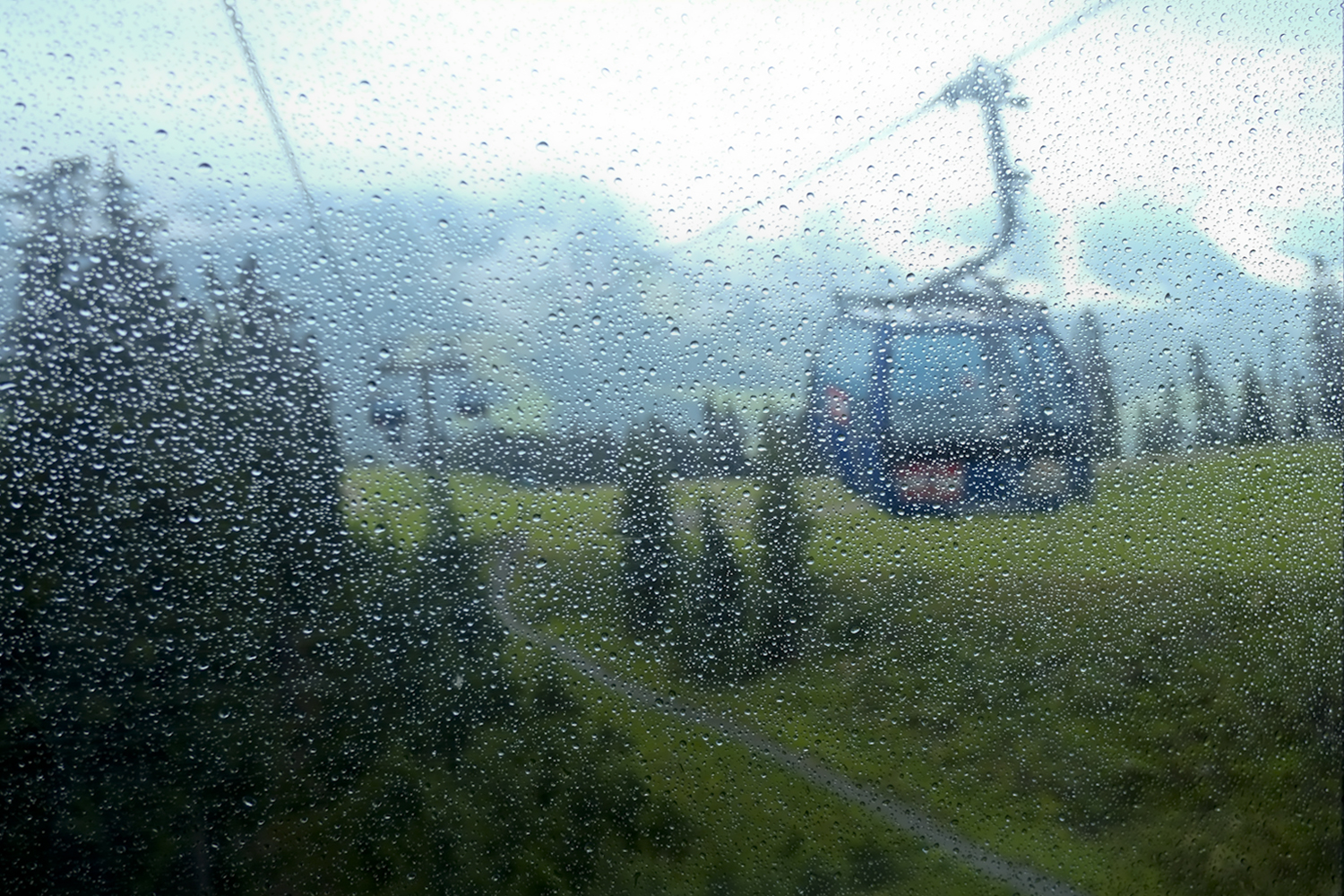
Every town seems to have at least one Gondola. If it’s sunny, ride up and walk down. If it’s rainy, ride roundtrip.
Rattenberg
We stayed the night at a Gasthaus in Leogang that has been run by the same family since 1471, so we figured that they probably knew the area fairly well. The hostess recommended that we stop in Rattenberg, a restored medieval town that specializes in hand blown glass. We didn’t see it in any of our guide books and it’s no wonder, it is the smallest town in the country.

Many of the older homes throughout Austria display religious figures or paintings that I think are designed to bless the house and it’s occupants.
* Useless But Interesting Fact #417: Rattenberg sits in the shadow of Rat Mountain and can get pretty gloomy in the winter. In November 2005, the town announced they were building 30 specialized rotating mirrors called heliostats to reflect sunlight into parts of the town during the dark months. The EU planned to foot half the bill for the $2.4 million operation. However, the project was never implemented.
Innsbruck
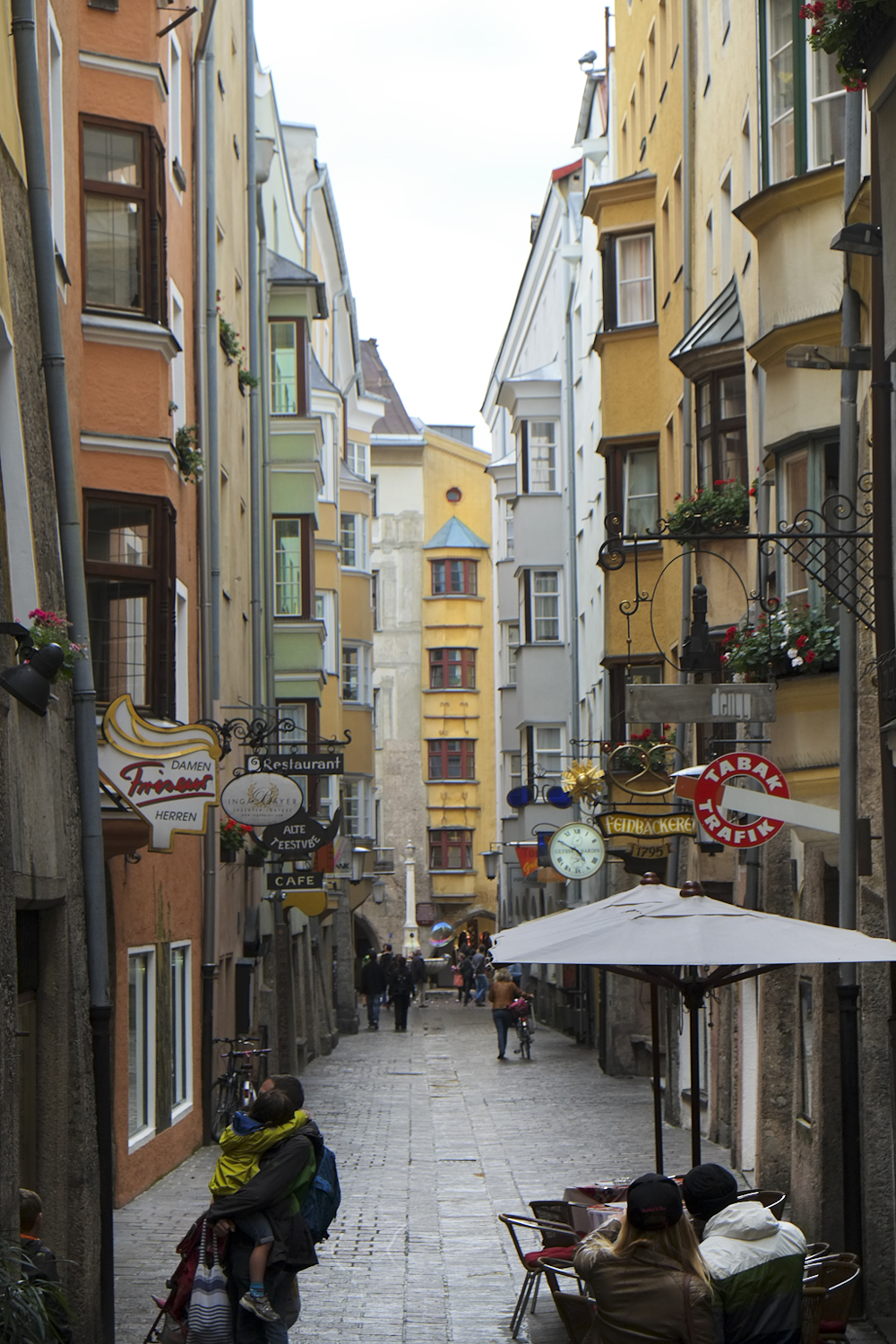
We had somehow imagined that Innsbruck would be a high end ski resort with hilly streets and exclusive ski chalets. Wrong! it’s about 20 km from the nearest ski slopes. Innsbruck is a big, beautiful and very busy city. It sits in the Inn valley beside the river Sill and is filled with thousands of tourists on a nonstop shopping spree.

Goldenes Dachl, the Golden Roof, is an oriel window added in 1500 and covered with 2,657 glided copper roof tiles.
Makin’ Bacon
This store sells Bacon. Nothing but Bacon. Every kind of Bacon you can imagine. I was outside taking the picture, two men stood next to me and when they realized what the store was, their eyes glazed over, their jaws dropped and in hushed reverent tones they slowly exclaimed, in unison, Wow.
This store is to men what shoe stores are to women.
Now I know that Bacon, like all really great stuff in this world, is bad for you and that we shouldn’t eat Bacon, but I keep telling myself that this is European Bacon. It has to better for you then crummy old American Bacon. I’ve almost convinced myself, that over here, this is a kind of high protein health food.
The other day I had a Bratwurst wrapped in Bacon. I haven’t had a cholesterol hit like that in years. My body is still tingling from the excitement. At my age a threesome is Bratwurst, Bacon and Beer.
The Great, the SoSo and the Run Like Hell
Before we got to Vienna we purchased lots of books about the city and it’s many attractions. Between these books and the many articles we’re read there have been tons of Top 10 lists. I thought it might be fun, for me at least, to review our most memorable 10. By way of a disclaimer I should point out that there probably isn’t anybody in the world that would agree with me. Even my wife thinks I’m full of malarkey.
The City
The Economic Intelligence Unit (EIU) does an annual Liveabilty Survey. With it’s low crime rate, great transportation system, sophisticated culture and architecture, Vienna is considered the second most livable city in the world. A little crowded at times but still nonthreatening, comfortable and easy to get around, it’s packed with great things to see. We loved it.
The Belvedere
Completed in 1723 as a summer residence for Prince Eugen of Savoy, this was the most ambitious building project ever undertaking by a private individual. It is now home to some of Austria’s greatest artistic treasures. We are here for the Secessionist Art and this is Ground Zero for that particularly Viennese art movement. This is the home of Gustav Klimt’s most celebrated work, “the Kiss”, and art lovers make pilgrimages here like they do to see the Mona Lisa at the Louvre. Masterpieces by all the great Secessionist artists like Egon Schiele, Oskar Kokoschka, Richard Gerstl and many more are on display, as well as all the great Impressionist. If you are an art lover this place needs to be on your bucket list.
The Secession Building
This large, white cubic Secessionist building was opened in 1897 to mixed reviewed. Critics called it everything from a warehouse to a public restroom. The quality of the art it contained was never in question, most of which was looted in World War II. The building was finally restored in the 70’s and today is considered one of the finest examples of the Secessionist period. I loved the building, I only wished there was more art. The basement has a room specifically designed to house the completely restored 110’ long fresco of Gustav Klimt’s “Ode To Joy”. With the exception of this masterpiece and a few sparse and pathetic contemporary pieces on the first floor the building was devoid of art, but perhaps one masterpiece and an outstanding building, is enough.
The Hofburg Palace
Have you ever been to Disney World on a holiday weekend? Paid a fortune to get in and then stood shoulder to shoulder in a hoard of humanity barely able to move. Now move the whole thing into an IKEA style rat maze. Replace all the products with a never ending row of glass cases filled with old silver, glassware and plates that you can’t get close enough to see. Then join an endless procession through a series of period rooms equipped with dress displays, dioramas and cut out figures as you try deperately to find the exit. Escape is futile.
If you want you avoid this, save your money and stay outside. The buildings, grounds and setting are magnificent.
Lipizanner Horses
These Spanish horses were brought to Austria by Emperor Maximilian II in 1562. Encouraged by their beauty, intelligence and stamina the Hofburg’s Spanish Riding School was established in 1572. In the summer the Riding School does training from 10 to 12 daily in an old arena next to the stables.
Wendi is a Montana girl and as such has an affinity for horses and insisted that we attend so she could see these beautiful animals in action. We stood in a long line at 8:45 am and waited patiently to fork over our 16 Euros each to watch this sold out event. The pictures advertising the event showed peppy horses leaping and prancing and running and rearing back on their haunches and marching in formation. We braced ourselves for the excitement.
All I can say is that between the 1 ¼ hours in line, the two hour “show” and the ¾ hours in the cheap café, there are 4 hours of my life that I will never get back.
There was no show and as far as I could tell and no training unless, of course, watching various horses and riders slowly wandering aimlessly around the arena for 2 hours can be called a show. At least 2/3 of the audience had fled within 45 minutes.
Sure I’m a little cynical, but I didn’t need them to bring out the barrels and the clowns or do any calf roping, just a little something that resembled the advertising would have been nice.
All the pictures you see were shot stealthily as young attendants circled through the crowd informing everyone that picture taking was strictly “verboten”. I can understand why. You would hate to have unauthorized images of this breathtaking extravaganza circulating on the internet. I did a little quick math based on seating capacity and ticket prices and won’t be surprised if this little scam netted over 3 million Euros a year.
On a positive note, the arena was very old and interesting.
Stephansdom
Considered Austria’s finest Gothic edifice, “Steffl” suffered severe damage from WWII bombing. It’s rebuilding was a symbol for hope for the country. If you like this sort of thing, it’s an A+.
Naschmarkt
Naschmarkt is the city’s largest market. The restaurant and food sections are opened everyday, but on Saturday’s local farmers arrive with their produce and a flea market sets up with hundreds of stalls. Needless to say, Wendi was, once again in heaven.
Time For Dessert
Oh yea, we love this stuff. You can’t come to Vienna without trying its most famous cake, the Sachertorte. Franz Sacher is said to have invented this chocolate cake, apricot jam and chocolate frosting concoction in 1832. We tried it twice to be sure, but unfortunately found it a little dry.
But oh, the equally celebrated Apfelstrudel with Whipped Cream was to die for. With a cup of good coffee, this is the stuff dreams are made of.
The Leopold
Located inside the courtyard of the Museumsquartier complex, this limestone cube is one of our favorite museums in the world. We were so intrigued that we spent two days at the Leopold just so we wouldn’t miss a thing. This outstanding building hosts a magnificent collection of Austrian art from the 1870s to the 1950s, including the world’s largest collection of Egon Schiele and a huge group of Gustav Klimt paintings. It is also surrounded by a courtyard filled with great restaurants. How can you go wrong?
Artists Tales of Sex, Betrayal and Untimely Death
EGON SCHIELE
In 1911, Schiele met the seventeen-year-old Walburga (Wally) Neuzil. Schiele and Wally wanted to escape what they perceived as a claustrophobic Vienna. They went to the small town of Krumau, the birthplace of Schiele’s mother. Despite Schiele’s family connections in Krumau, he and his lover were driven out of the town by the residents, who strongly disapproved of their lifestyle, including his alleged employment of the town’s teenage girls as models. They moved to Neulengbach where Schiele’s studio became a gathering place for the town’s delinquent children. The artist’s way of life aroused much animosity among the town’s inhabitants, and in April 1912 he was arrested for seducing a young girl below the age of consent.
When they came to his studio to place him under arrest, the police seized more than a hundred drawings which they considered pornographic. Schiele was imprisoned while awaiting his trial. When his case was brought before a judge, the charges of seduction and abduction were dropped, but the artist was found guilty of exhibiting erotic drawings in a place accessible to children. In court, the judge burned one of the offending drawings over a candle flame. The twenty-one days he had already spent in custody were taken into account, and he was sentenced to only three days’ imprisonment. While in prison, Schiele created a series of 12 paintings depicting the difficulties and discomfort of being locked in a jail cell.
In 1914, Schiele glimpsed Edith Harms, who lived with her parents across the street from his studio in Vienna. Schiele chose to marry the more socially acceptable Edith, but had apparently expected to maintain a relationship with Wally. However, when he explained the situation to Wally, she left him immediately and never saw him again. Despite some opposition from the Harms family, Schiele and Edith were married on June 17, 1915, the anniversary of the wedding of Schiele’s parents.
In the autumn of 1918, the Spanish flu pandemic that claimed more than 20,000,000 lives in Europe reached Vienna. Edith, who was six months pregnant, succumbed to the disease on 28 October. Schiele died only three days after his wife. He was 28 years old. During the three days between their deaths, Schiele drew a few sketches of Edith; these were his last works.
RICHARD GERSTL
In 1906 the 22 year old Richard Gerstl, then an Academy student, met composer Arnold Schonberg and asked him to sit for a portrait. Gerstl admired the older composer and viewed him as somewhat of a father figure. During this time the young Gertl met Schonberg’s wife Mathilde and began to paint portraits of her as well. During the summer of 1907 the relationship developed into love. Schonberg suspected the liaison and during a summer vacation in 1908 caught the lovers “in flagrante”. Mathidle left Schonberg and her children but was soon persuaded to return for the sake of society and her family. The depressed Gerstl was cut of from Schonberg’s social circle and on the night of November 4, 1908 committed suicide. Mathilde became taciturn and shunned her husband’s company from that day on. All of the young artist’s paintings were packed away in boxes and stored in a warehouse. In 1931 art dealer Otto Kallir discovered Gerstl’s work and organized an exhibit in Vienna.
This was the first time Gerstl’s work was ever shown in public.

Our landlord at the Liesel/Pierre gave us lots of great visiting tips that turned out to be indispensable. In regards to sightseeing, he indicated that the old inner city was small and compact enough that we might want to avoid the numerous commercial touring schemes and set out on foot to explore.
This turned out to be great advice, but in terms of picture taking it has lent itself to a lot of this and that. So that’s how we’ll finish up our trip to Budapest, in bits and pieces with a few frayed ends.
Meaning “satellite” or “companion” in German, the Trabants were produced in East Germany. Originally, you’d pay for the car then be put on a list and wait for as long as 6 to 8 years for delivery. This meant that used Trabants sold for more then new ones. The downside was they ran like crap, were smokey as hell and produced 10 times the pollution of conventional cars. The upside was that they were manufactured, almost entirely, from recycled materials. The Trabant was regarded with derisive affection as a symbol of the extinct former East Germany and the fall of the Eastern bloc.
I have absolutely no idea what any of these people are selling.
Public baths were introduced by the Turks of the Ottoman Empire and are a huge part of popular culture. They are great facilities that have swimming pools (with three different temperatures), saunas, thermals, restaurants, cabins and anything you might need to have a great day. Two of the most popular are the Gellert Baths at the luxurious Hotel Gellert and the Szechenyl Baths at the city park. We spent the day at Szechenyl.
The Great Synagogue or Tabakgasse Synagogue is the largest synagogue in Europe.
Shoes on the Danube Bank is a bronze sculpture that honors the Jews who were killed by fascist Arrow Cross militiamen in Budapest during World War II. It depicts one of the saddest stories in modern Hungarian history.
All the rest.
Lets top it off.
That’s all for now. See you in Austria.
I love public transportation. Perhaps because, at home, we have so little of it and what we do have seems so grossly inefficient, which is something we can probably blame on constant lobbying efforts by the automobile industry, but I digress.
In Budapest, between trains, trams and buses, there isn’t a location you can’t get to within a block of. If you weren’t in the delivery business, I can’t imagine why you would want to deal with a car.
We purchased 7 day passes that allow us to use any trains, trams or buses and cost only about $3 a day, half that if you are a EU citizen. We have used it constantly. This is the best sightseeing buy in town.
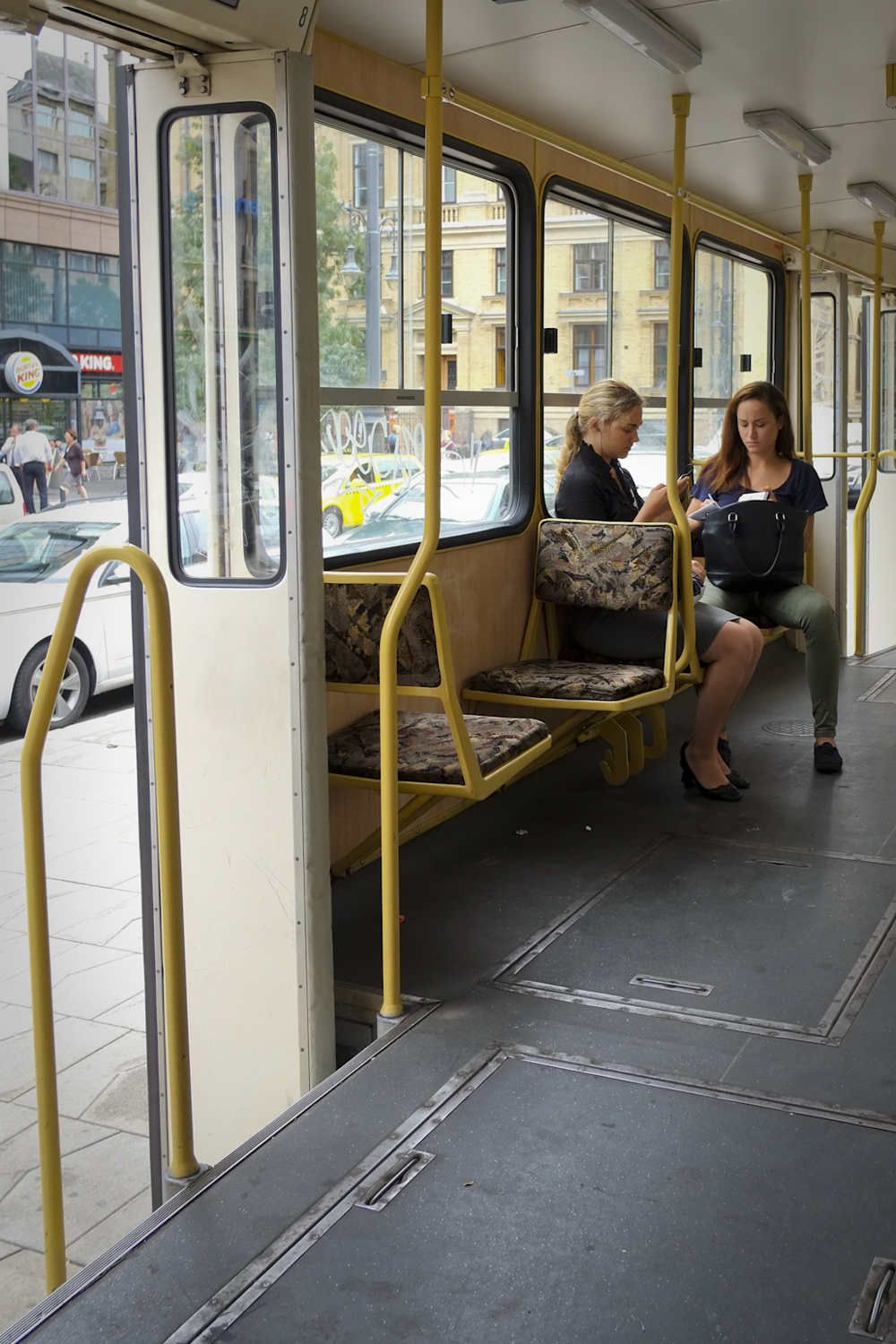
The trams are great fun. A little old fashioned, they are all above ground and wind their way through the old city center giving you passing views of all the city’s most fascinating locations. The #2 line, which hugs the Danube from one end of the city to the other and affords great views of monumental government buildings, palaces and bridges, is my favorite.
The Budapest Metro is particularly interesting. It is the oldest electrified underground railway system on the European continent, and the second-oldest in the world, predated only by the 1890 City & South London Railway. Its iconic Line 1, completed in 1896, was declared a World Heritage Site in 2002.
Line 1
The Metro has expanded over the years by renovating and adding new updated lines while preserving and restoring it’s older historic parts.
Lines 2 and 3 are newer but still date from the at least the 60s.
Stations on the 4 and 5 Lines represent more state of the art.
My wife is flea market crazy. I don’t mean that she likes or is slightly interested in flea markets. Oh no, she’s completely and totally bonkers, nuts, out of her ever lovin’ skull, just can’t get enough of, crazy about flea markets. She has dragged me to the most God awful, disgusting, trashy yard sales, jumble sales, boot sales, garage sales and impromptu street markets in broken down Grange Halls, dilapidated industrial sites, abandoned warehouses, trash strewn vacant lots, very scary dead end streets and deserted parking garages in every city we have ever visited just so I can have the immense pleasure of gazing upon and fondling acres of other people’s useless and discarded junk.
Budapest has proven to be an exception to this otherwise nightmare scenario. Wendi has coerced me into two flea markets here and, I have to admit, they are terrific. Big, sprawling old school Markets, untouched by the tidal wave of cheap third world tshirts and trinkets. These are Markets were you can still find hidden gems and long forgotten items for a bygone era. Exactly the kind of Markets that made them popular to begin with.
Our first stop was at the Szechenyl Market is the middle of the large city park. The smaller of the two, Szechenyl has a bit of a yard sale feel but was still really interesting.
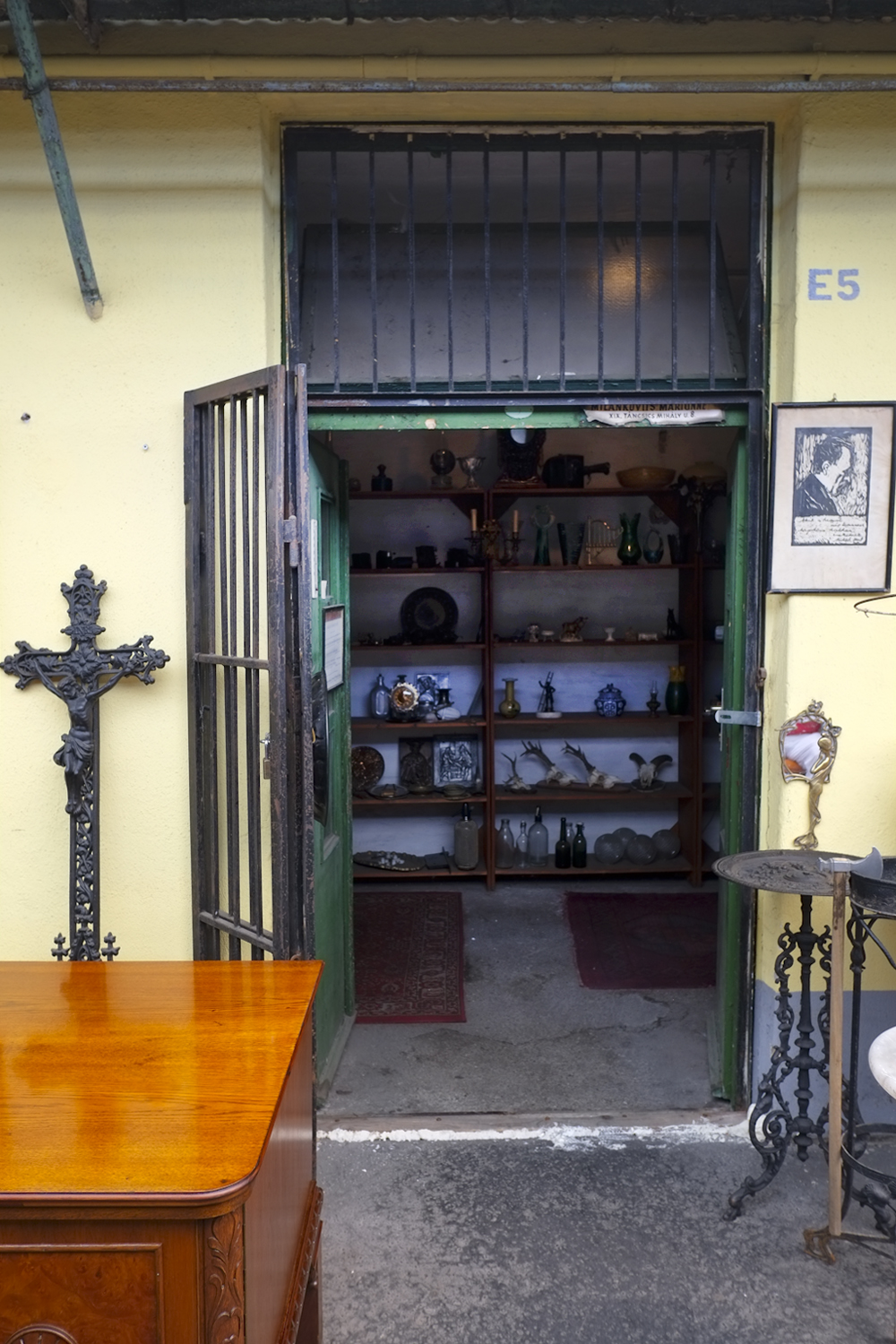
Our last visit was at the Ecseri Market and it is the pièce de résistance. Located in the suburbs southwest of Budapest, getting there required two Metro transfers and a 20 minute bus ride, but was well worth the effort. A truly terrific treasure trove.
Better hurry, this kind of market is rapidly disappearing.